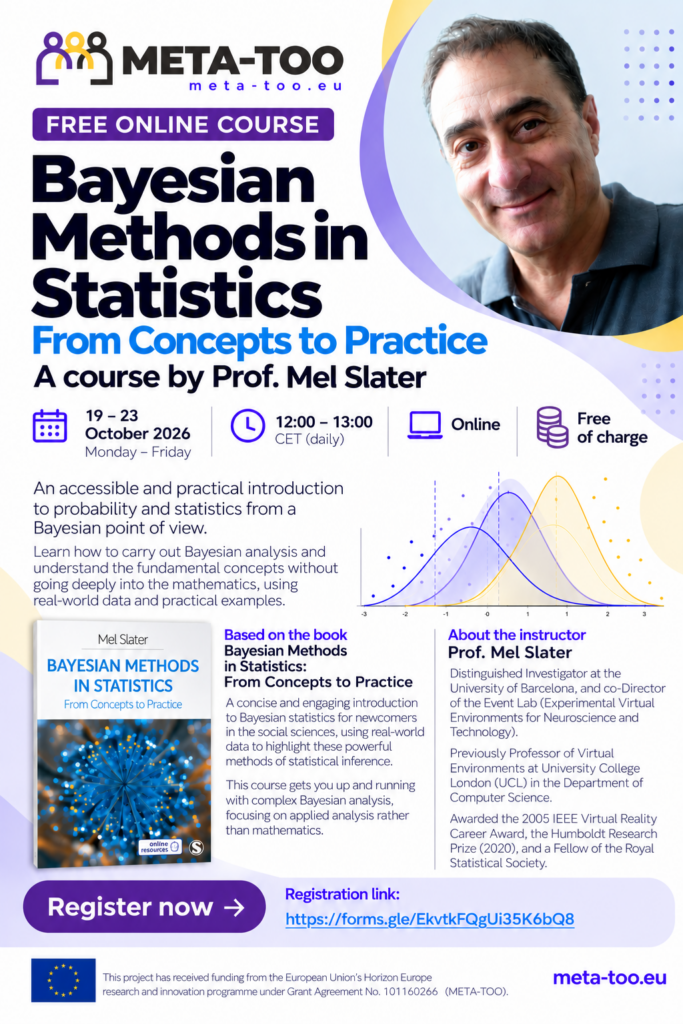
META-TOO is pleased to invite researchers, PhD students, early-career researchers, and anyone interested in Bayesian statistics to a free online course with Prof. Mel Slater.
Bayesian Methods in Statistics: From Concepts to Practice
19–23 October 2026 | Monday–Friday
12:00–13:00 CET daily
Online | Free of charge
The course provides an accessible and practical introduction to probability and statistics from a Bayesian point of view. Its aim is to enable participants to carry out Bayesian analyses while understanding the fundamental concepts behind them, without going deeply into the mathematics.
Beginning with the foundations of probability, the course introduces Bayes’ Theorem and explores how it forms the basis of Bayesian statistical inference. Through practical examples and real-world data, participants will learn how Bayesian methods can be applied to research questions and statistical analysis.
Based on the book
The course is based on Prof. Mel Slater’s book, Bayesian Methods in Statistics: From Concepts to Practice.
The book offers a concise and engaging introduction to Bayesian statistics, particularly for newcomers in the social sciences. Both the book and the course emphasize applied analysis and practical understanding rather than mathematical complexity.
About Prof. Mel Slater
Prof. Mel Slater is a Distinguished Investigator at the University of Barcelona and co-Director of the Event Lab (Experimental Virtual Environments for Neuroscience and Technology). He was previously Professor of Virtual Environments in the Department of Computer Science at University College London (UCL).
He received the 2005 IEEE Virtual Reality Career Award in recognition of his pioneering achievements in the theory and applications of virtual reality and the Humboldt Research Prize in 2020. He is a Fellow of the Royal Statistical Society.
Registration
Participation is free, but registration is required.
The course is organized in the framework of META-TOO.
Please feel free to share this opportunity with colleagues, students, researchers, and others who may be interested.
This project has received funding from the European Union’s Horizon Europe research and innovation programme under Grant Agreement No. 101160266 (META-TOO).