
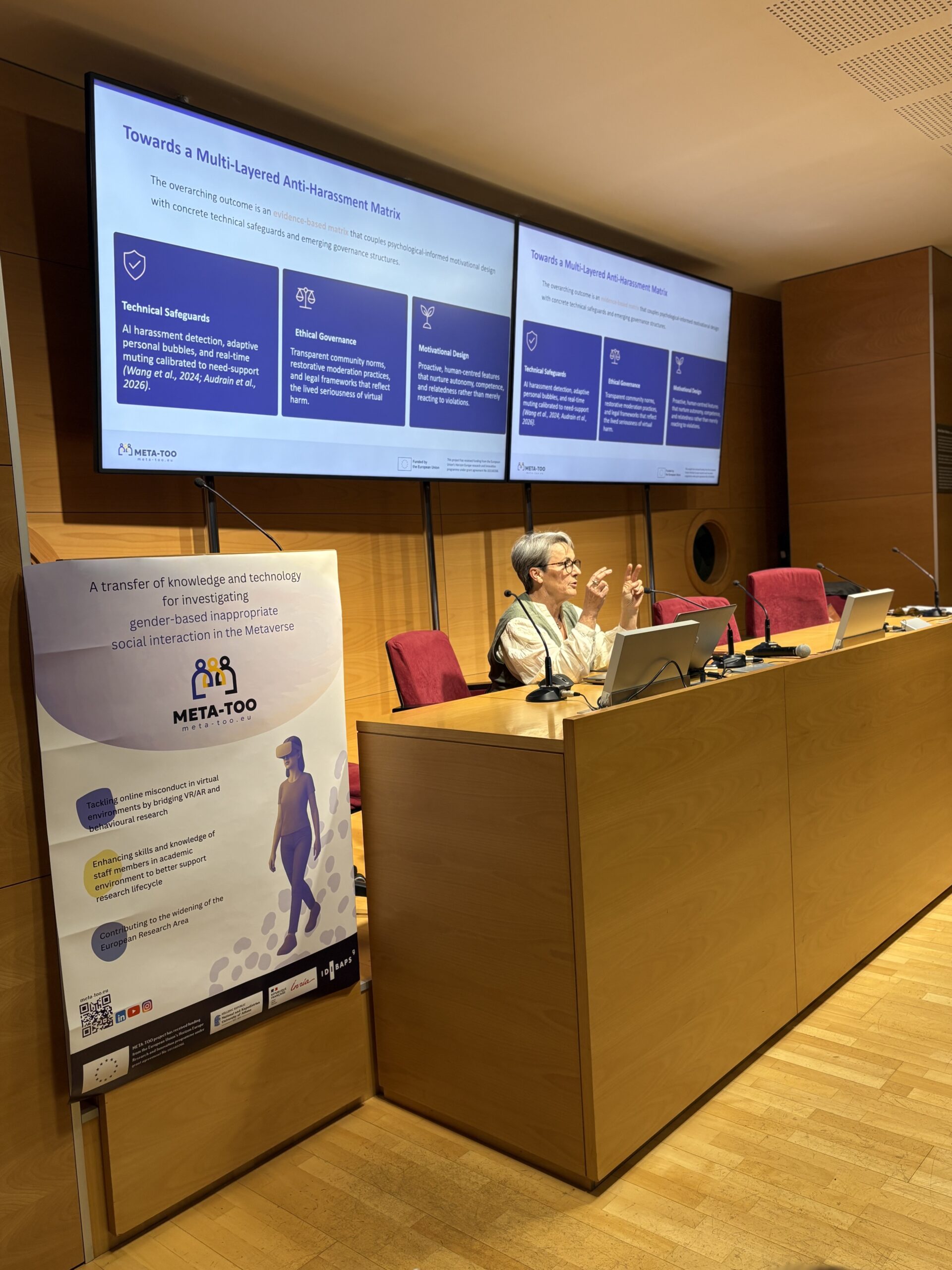
At a time when social virtual reality (VR) is rapidly evolving into a mainstream medium for communication, collaboration, and identity expression, META-TOO project “A transfer of knowledge and technology for investigating gender-based inappropriate social interactions in the Metaverse” addresses a critical gap: the lack of proactive, theoretically grounded approaches to harassment and harmful social interactions. By integrating expertise from computer science, psychology, and ethics, the project seeks to move beyond reactive moderation tools toward systemic, human-centered design principles that support user well-being and social integrity.
META-TOO project is a Horizon Europe initiative addressing the ethical, social, and technological challenges of interaction in immersive environments. Funded under the EU WIDERA programme (Grant Agreement No. 101160266) and running from June 2024 to May 2027, the project brings together the National and Kapodistrian University of Athens (NKUA, Greece), the National Institute for Research in Digital Science and Technology (INRIA, France), and the Institut d’Investigacions Biomèdiques August Pi i Sunyer (IDIBAPS, Spain). The consortium aims to strengthen research capacity while advancing interdisciplinary knowledge on safety and inclusion in the metaverse.
Ethics at the Core: The Barcelona Workshop

A central milestone in the project was the META-TOO ethics workshop held in Barcelona in April 2026. Far from being a purely technical meeting, the workshop was explicitly designed as a space for ethical inquiry, bringing together not only the project partners but also external experts from institutions such as the University of Würzburg, the University of Bamberg, the Univ. Catholique de Louvain, the Monash University and the University of Barcelona.
The workshop designed and led by Michèle Barbier, independent ethics expert for the European Commission and member of the Operational Committee for the assessment of Legal and Ethical risks at Inria, foregrounded a key premise: harassment in social VR is not only a technical problem but a fundamentally ethical one, requiring reflection on human experience, social norms, and responsibility in immersive environments.
To establish the conceptual and ethical landscape, sessions examined the current ecosystem of safety tools, highlighting their limitations as largely reactive and fragmented responses. These discussions were complemented by philosophical perspectives, which underscored the difficulty of defining and regulating harmful behavior in contexts where embodiment, presence, and identity are fluid and often ambiguous. Particular attention was given to the notion of virtual personal space, raising questions about how boundaries are perceived, violated, and protected in immersive environments.
A distinctive feature of the ethics session was its engagement with philosophical and normative questions for design. Rather than asking only what works, participants explored what ought to be designed and on what ethical grounds. This included critical reflection on power asymmetries, the experiences of marginalized users, and the extent to which platform architectures shape or constrain agency and responsibility.
The discussion also extended to emerging domains such as the use of embodied AI in mental health contexts, where immersive technologies introduce new ethical considerations related to vulnerability, trust, and user autonomy. These conversations highlighted the need for safeguards that go beyond technical functionality, incorporating principles of care, accountability, and transparency.
From Ethical Reflection to Structured Frameworks
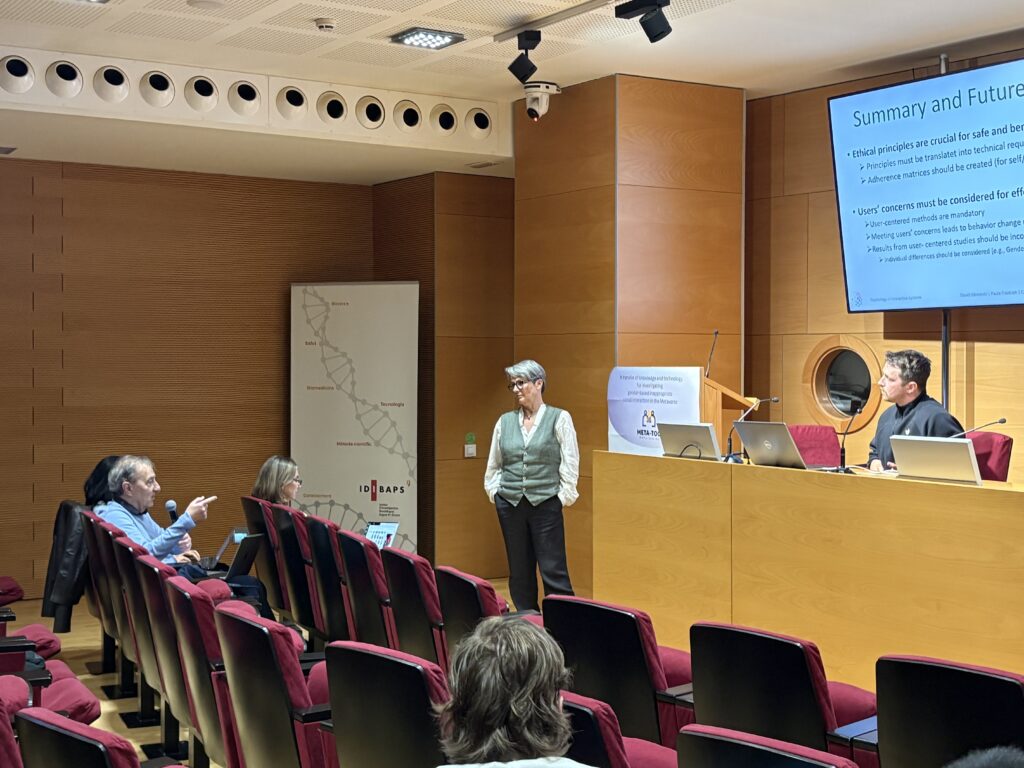
Building on these discussions, the workshop introduced a structured framework for evaluating social experience in VR across intrapersonal, interpersonal, and interaction-level dimensions based on the work of Wei et al., 2024. This framework served as a bridge between ethical principles and concrete design practices, enabling participants to systematically analyse how different features and interventions shape user experience.
To translate ethical reflection into collaborative design work the interdisciplinary groups examined existing safety features, such as personal boundaries, moderation systems, and AI-based detection tools, through the lens of human needs and values. They also explored how community norms are established and how immersive environments can be designed to promote prosocial behavior rather than merely suppress harmful actions.
A key outcome of this process was the recognition that ethics must be embedded at multiple levels of system design. Effective interventions cannot be limited to isolated features; they must integrate user interface design, interaction mechanics, governance structures, and cultural norms into a coherent approach to safety.
The work initiated during the workshop is continuing through dedicated working groups and will culminate in a White Paper outlining recommendations on ethical design for gender equality in immersive environments. This document aims to provide both conceptual clarity and practical guidance for researchers, developers, and policymakers.
Beyond the Workshop: Building Capacity and Impact
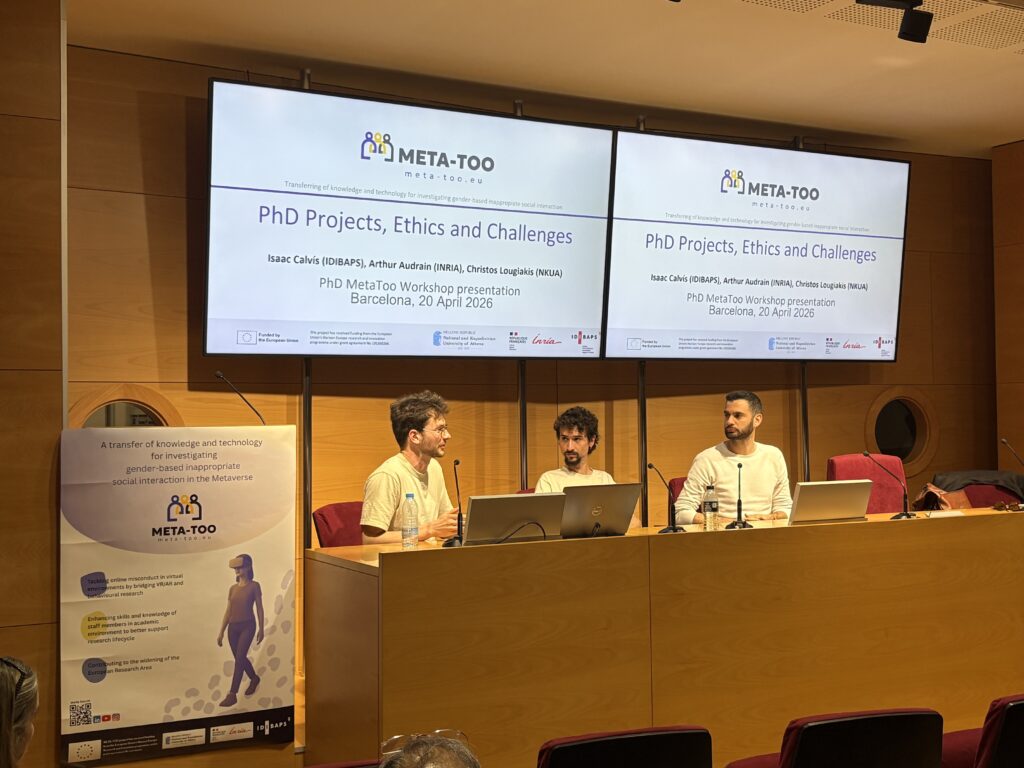
The ethics workshop is part of a broader set of activities through which META-TOO seeks to strengthen research excellence and institutional capacity. As an EU WIDERA twinning action focused on research-capacity building, the project emphasizes knowledge transfer and long-term collaboration between NKUA, INRIA, and IDIBAPS. Ongoing initiatives include research exchanges, training across the research lifecycle, and the development of tools and guidelines for effective knowledge transfer and innovation.
META-TOO also actively engages with the international research and policy community. Contributions to IEEE VR 2026 (including the IDEATExR workshop on inclusion and ethics in XR) and CHI 2026 reflect its commitment to shaping discourse at the intersection of technology, ethics, and society. This engagement extends to policy and interdisciplinary forums, including the Human Rights in Immersive Realities (XR)conference, organized by the Council of Europe and the European Media Regulation Network, and the Embodiment: 20 Years On in Venice Biennale. Together, these activities reinforce META-TOO’s role in connecting research with broader societal and regulatory debates.

Toward Ethical Virtual Futures
What distinguishes META-TOO is its insistence that ethical considerations are not external constraints on innovation, but foundational elements of design. The Barcelona workshop made clear that addressing harassment in social VR requires more than improved tools; it demands a rethinking of how virtual environments are conceptualized, built, and governed.
By embedding ethical reflection into interdisciplinary collaboration, META-TOO contributes to a broader European effort to ensure that immersive technologies evolve in ways that respect human dignity, promote inclusion, and foster meaningful social interaction.
As virtual worlds become increasingly integrated into everyday life, such efforts will be essential in shaping digital spaces that are not only technologically advanced, but also socially responsible and ethically grounded.
Stay Connected
Together, these activities reflect META-TOO’s broader ambition: to connect expertise across computer science, psychology, and ethics to support the development of safer, more inclusive, and more responsible virtual worlds.
To stay updated on META-TOO activities, publications, and upcoming events, follow our updates on the website, LinkedIn, YouTube, and Instagram.